[Doc] JSA for 137 differents job on doc format ...

A Job Safety Analysis (JSA) lists the steps of a task, the hazards in each step and the controls that keep people safe. This free JSA index covers 65 job safety analyses for lifting and hoists, hot work, tank entry, electrical work, diving, saturation systems and high-pressure gases. Browse the pages below or download the full set in Word format.

  • 65 JSAs
  • 9 categories
  • Word download

Job Safety Analysis Index (Pages 1–5)

The index below shows every JSA in the collection. Click a page to see it at full size.

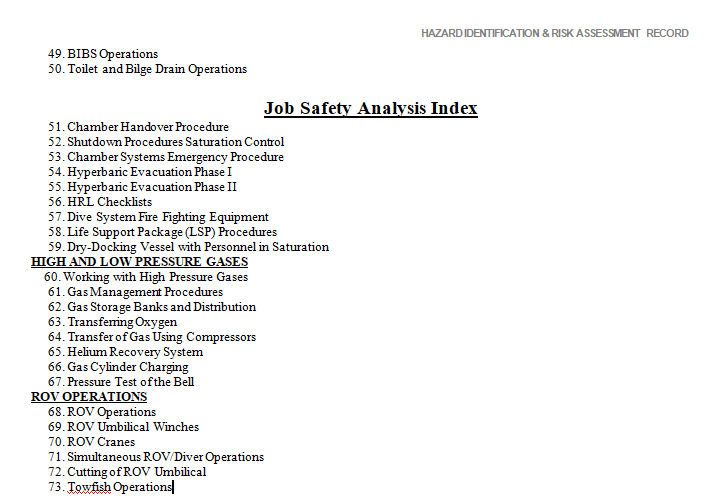
Job Safety Analysis (JSA) index page 1 of 5 – marine, lifting, hot work, diving and gas operations
JSA index – page 1 of 5. Click to enlarge.
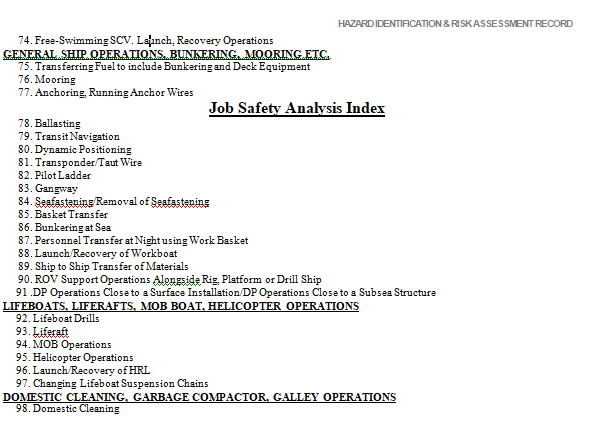
Job Safety Analysis (JSA) index page 2 of 5 – marine, lifting, hot work, diving and gas operations
JSA index – page 2 of 5. Click to enlarge.
Job Safety Analysis (JSA) index page 3 of 5 – marine, lifting, hot work, diving and gas operations
JSA index – page 3 of 5. Click to enlarge.
Job Safety Analysis (JSA) index page 4 of 5 – marine, lifting, hot work, diving and gas operations
JSA index – page 4 of 5. Click to enlarge.
Job Safety Analysis (JSA) index page 5 of 5 – marine, lifting, hot work, diving and gas operations
JSA index – page 5 of 5. Click to enlarge.

Full List of 65 Job Safety Analyses by Category

Tap a category to see its JSAs. The numbers match the index pages above.

Deck Activities and Surface Maintenance 2 JSAs
  1. Deck Activities
  2. Surface Maintenance
Lifting Operations, Winches and Hoists 8 JSAs
  1. Lifting and Moving Equipment
  2. Load Testing Winch
  3. Tugger Winches
  4. Chain Hoists
  5. Crane Operations
  6. Crane Testing
  7. Operating Air and Hydraulic Deck Winches
  8. ‘A’ Frame Operations
Cutting, Welding, Grinding and Hot Work 2 JSAs
  1. Deck Welding Operations
  2. Welding, Grinding and Burning
Oils and Chemicals 2 JSAs
  1. Working with Oils
  2. Working with Chemicals
Working at Heights, Overboard and Confined Spaces 6 JSAs
  1. Working at Heights
  2. Working Overboard
  3. Manhole Covers
  4. Fresh Water Tanks Entry
  5. Ballast Tank Entry
  6. Fuel Oil Tank Entry
Electrical Work, Power Tools and Moving Machinery 8 JSAs
  1. Working with Lighting Equipment
  2. Starting Electrical/Hydraulic Power Units
  3. Operating Workshop Machinery
  4. Working Inside Main Switchboard
  5. Working/Running Machinery
  6. Working on Electrical Equipment
  7. Working with Power Tools
  8. Working with Batteries
Diving System Operations 16 JSAs
  1. Bell Control Procedures
  2. Bell Control Checklists
  3. Reclaim
  4. Bell Diving Procedures
  5. Bell Diving Checklists
  6. Bell Handling Procedures
  7. Hot Water System
  8. Bell Handling Emergency Procedures
  9. Simultaneous ROV/Diver Operations
  10. Shallow Water Diving
  11. Shallow Water Diving Using Extended Umbilicals
  12. Diving Inside An Anchor Pattern
  13. Diving Operations Alongside a Platform
  14. Diving in the Vicinity of a Subsea Structure
  15. Dynamically Positioned Diving Operations
  16. Emergency Recovery of the Sat Diving Bell at Water Depths Greater than 50 Meters
Saturation System 15 JSAs
  1. Communications Procedures
  2. Chamber Control Checklists
  3. Chamber System Checklists
  4. Medical and Equipment Lock Operations
  5. BIBS Operations
  6. Toilet and Bilge Drain Operations
  7. Chamber Handover Procedure
  8. Shutdown Procedures Saturation Control
  9. Chamber Systems Emergency Procedure
  10. Hyperbaric Evacuation Phase I
  11. Hyperbaric Evacuation Phase II
  12. HRL Checklists
  13. Dive System Fire Fighting Equipment
  14. Life Support Package (LSP) Procedures
  15. Dry-Docking Vessel with Personnel in Saturation
High and Low Pressure Gases 6 JSAs
  1. Working with High Pressure Gases
  2. Gas Management Procedures
  3. Gas Storage Banks and Distribution
  4. Transferring Oxygen
  5. Transfer of Gas Using Compressors
  6. Helium Recovery System

Download the JSA in Word Format

Get the editable Word version to adapt for your own site and crew.

Download JSA (Word format) Download JSA document

Job Safety Analysis (JSA) FAQ

What is a Job Safety Analysis (JSA)?

A JSA breaks a job into steps, identifies the hazards in each step and sets out controls to remove or reduce the risk before the work starts.

Who should use a JSA?

Supervisors, safety officers and work crews. It is used before high-risk tasks such as lifting, hot work, tank entry, electrical work and diving operations.

What does this JSA collection cover?

It indexes 65 JSAs across deck work, lifting and hoists, hot work, oils and chemicals, working at height, confined spaces, electrical work, diving, saturation systems and pressure gases.

Can I download the JSA in Word format?

Yes. Use the download button in this post to open the Word-format document.

Can I use these JSAs as they are?

Treat them as a starting template. Review and adapt each JSA to your site, equipment, crew and current conditions, and have it approved by a competent person.

Waiting for Your Valuable Comments 👇👇👇

Comments

Post a Comment

Thanks for Your great replay .....

Popular posts from this blog

NEBOSH IGC -01 Importent Questions & Answers

UNIT IGC1: MANAGEMENT OF INTERNATIONAL HEALTH AND SAFETY Element 1: Foundations in Health and Safety 1.     Replacement or repair of damaged plant and equipment is a cost that an organization may face following a workplace accident. List EIGHT possible costs to the organization following a workplace     accident (or)                   (8) Identify the possible cost to an organization following an accident in the workplace. (or) (8) Identify possible costs to an organization resulting from inadequate health and safety standards.                                                (8) (1-5) Direct Costs: ·      ...

NEBOSH IGC-2 Very useful Questions & Answers Part-1

UNIT IGC2: CONTROL OF INTERNATIONAL WORKPLACE HAZARDS Element 1: Workplace hazards and risk control 1.      Outline the welfare facilities that should be provided in the building                                                             (8) Drinking water – Access to wholesome drinking water. If non-potable water is also available then supplies should be clearly labeled to distinguish between the two. Sanitary conveniences – access to a sufficient number of sanitary conveniences (WCs) for the number of workers present with separate facilities for men and women. They should be protected f...

Safety Officer's WhatsApp Group Link .

Safety Officer WhatsApp Groups | HSE Professional Networking Join Safety Officer WhatsApp Groups Connect, Learn, and Grow with HSE Professionals Worldwide Why Join the Community? Knowledge Sharing: Advice on protocols and HSE insights. Stay Updated: Real-time news on industry standards and regulations. Networking: Connect with global safety experts. Job Opportunities: Access to exclusive safety job postings. Safety Officer Gulf Join Group Safety (Study & Job) Join Group Safety Officer Jobs Join Group Group Guidelines To ensure a productive environment, please follow these rules: Respect:...

NEBOSH IGC-2 Exam Questions & Answers Part-2 (very very useful and simple )

    Element 5: Electrical safety 1. Identify the possible effects of electricity on the body. (page no: 5-2) § Electric shock – severe electric shock can cause involuntary muscle grip, heart fibrillation, respiratory failure and cardiac arrest. § Burns – burns can also result from an electric shock, at the point of contact and at the point that the current flows out of the body. There may also be internal burns along the current path. § Fire and explosion. § Arcing. § Secondary effects. 2. Outline four factors that may affect the severity of injury from contact with electricity (page no: 5-3) Several factors influence the severity of injury associated with receiving an electric shock: Voltage – as Ohm’s law shows there is a simple relationship between voltage and current, the higher the voltage, the greater the current. Duration – the length of time that a person is exposed to the flow of electricity is critical. For example, a current flow of 60 mA for 30 ...

100 Safety Topics for Daily Toolbox Talk !!!!!!!!! [DOC]

100 Safety Topics for Daily Toolbox Talk | Workplace Safety Guide 100 Safety Topics for Daily Toolbox Talk 100 Safety Topics for Daily Toolbox Talk is a complete workplace safety resource designed for daily toolbox meetings, HSE training sessions, safety awareness programs, and industrial safety compliance . What is a Safety Toolbox Talk? A toolbox talk is a short safety discussion conducted at the workplace to highlight hazards, safe work practices, and accident prevention methods. Why Daily Toolbox Talk is Important? Prevents workplace accidents and injuries Improves employee safety awareness Ensures compliance with HSE standards Creates a strong safety culture Key Safety Topics Covered Fire and Fire Fighting Systems Electrical Safety and Shock Hazards Personal Protective Equipment (PPE) First Aid and Emergency Response Workplace, Road, and Home Safety Index of 100 Safety Topics for Daily Toolbox Talk What is Fire Classes of Fires an...